Come on. 2011? The final fix on the Longfellow Bridge won't begin until 2011?
I hadn't been a daily red line user in five years, but now that I'm moving regularly between Cambridge and South Station this two mile stretch of track is essential to me.
And it sucks. It's not just that the Longfellow Bridge is broken and the trains are required to creep over it at 5mph. Not just that you can expect multi minute waits at multiple stations on most rides. Or the uncanny frequency of "electrical problems" or "switching issues" causing thousands of frustrated, sweating riders to squirm uncomfortably in intimate proximity as they waste their mornings and evenings trapped underground. Again.
Nope. It's that this is happening on a vital piece of urban technology running through one of the densest populations of big brains on the planet (amazingly, less than 200m from the Volpe Transportation Center). And no one can manage to plan and execute a solution that will, in the most optimistic of circumstances, take less than five years and $250 million to deliver. In the midst of an incipient energy crisis. Where dependence on efficient and dependable mass transit can only grow.
So very lame.
Monday, June 30, 2008
Monday, February 18, 2008
american teleocracy
tel·e·oc·ra·cy (tµl"¶-¼k"r…-s¶, t¶"l¶-) n., pl. tel·e·oc·ra·cies. 1. Philosophy, Political Science. Design or purpose in government or society; goal directed rule. 2. The use of ultimate purpose or design as a means of explaining government or social dynamics. 3. Purposeful development, as in the trajectory of a state or civilization, toward a final end; a government of objectives. [Greek teleios, teleos, perfect, complete (from telos, end, result) + -cracy.] --tel"e·o·crat"ic (-¹k) adj. --tel"e·o·crat"i·cal·ly adv.
but, other than just ever greater consumption, is there really any american purpose?
pavor nocturnus + thundersnow
Some of the worst dreams of my life have occurred during thunderstorms. Often this has happened in unfamiliar places or when the storms happen unexpectedly in cold seasons. There was an opportunity for one of these the other night, a rare winter snow-and-lightning combination, but I woke up when I heard my 3-year old daughter's voice from downstairs, not from dreams of my own.
I didn't even know there was thunder when I went down to calm her. She was having night terrors, which means she wasn't actually awake, but was moaning and yelling from a submerged state of deep slow-wave-sleep. When I sat on her bed I saw the lighting and heard the thunder for the first time. It sounded so close. I pushed the shades aside and peered out into the street. Heavy snow was falling. Two or three inches was on the ground and no plow had been by yet. There was another flash and for its terrifying duration I saw a woman standing on the sidewalk across the street, looking up at our house. Her clothing seemed soaking wet. Without the flash she was invisible. I quickly closed the shade.
I lay down with my daughter for a few minutes until she settled back to quiet sleep. There were some fading thunderclaps, but no more lightning after that. When I left her room and looked out to the street there was only untracked snow in the dim streetlights. I went from window to window to look for footprints, for any sign of that woman, half expecting a face to pop into view from the darkness as I leaned toward the glass. Nothing though. No footprints. Just the snow.
I didn't even know there was thunder when I went down to calm her. She was having night terrors, which means she wasn't actually awake, but was moaning and yelling from a submerged state of deep slow-wave-sleep. When I sat on her bed I saw the lighting and heard the thunder for the first time. It sounded so close. I pushed the shades aside and peered out into the street. Heavy snow was falling. Two or three inches was on the ground and no plow had been by yet. There was another flash and for its terrifying duration I saw a woman standing on the sidewalk across the street, looking up at our house. Her clothing seemed soaking wet. Without the flash she was invisible. I quickly closed the shade.
I lay down with my daughter for a few minutes until she settled back to quiet sleep. There were some fading thunderclaps, but no more lightning after that. When I left her room and looked out to the street there was only untracked snow in the dim streetlights. I went from window to window to look for footprints, for any sign of that woman, half expecting a face to pop into view from the darkness as I leaned toward the glass. Nothing though. No footprints. Just the snow.

Saturday, January 19, 2008
the pessimist's coming rapture (an eschatological litany):
agriculture failure + famine | bioaccumulation overload | climate collapse | dirty bombing outbreak | drought + desertification | electromagnetic pulse event | energy crash | extinction spasm | food-biofuel conflict | global economic rupture | habitat disintegration | ice sheet collapse (west antarctic + greenland) | livestock epizootic | nano-plague | refugee deluge | singularity recursion | uncontained pandemic
Tuesday, January 15, 2008
us residential real estate plunge
Case Shiller maintains a really nice index for tracking the value of single family homes in the US. It's a broad index, and is actually specific to only 20 US urban markets, but it contains lots of carefully vetted data points and is very dependable as a national metric. It's released the last Tuesday of every month.
The story it is telling right now is kinda bleak. If you look at the year over year change back to the late 1980's, the last year and a half are a precipice:
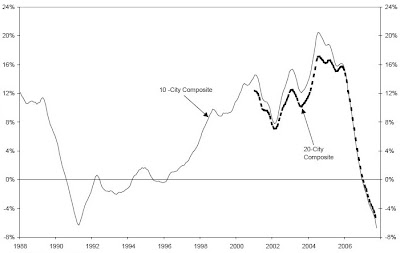
And if look at individual performance of the 20 individual markets over the same 20 year period you get this thing:
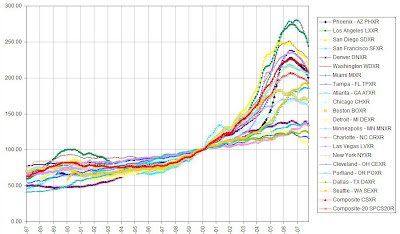
Click it into its own page if you want to read it, but that's not really necessary. The trend is the trick. A dozen of these cities (note especially LA, Miami, San Diego and DC at the top of the bubble) have peaked so completely out of line with their historic curves that there's no hope of getting them moving back upward any time soon. Since many of these markets are still at more than 200% of their January 2000 index value they'll probably fall for another year at least - without even considering energy or currency crisis possibilities.
If the lines settle back down somewhere near the 2000-2001 baseline and make nice, neat bellcurves of themselves, well, oops. There's something like 5 trillion dollars of value under that curve. With that gone (and the equity markets flat or falling, which seems sort of inevitable) it doesn't look like we'll be feeling so flush over the coming years.
I think it's safe to say that this sort of residential value inflation, while natural and common as a local phenomenon, is a very bad sign when it happens across the entire national economy. And perhaps we should rethink the policy of making credit so readily accessible for residential real estate speculation (like for the millions of houses that were bought not to be owner-occupied but purely to make money riding the wave up). Because it is one thing to watch your stock portfolio crash - it's a very different thing to lose your home.
The story it is telling right now is kinda bleak. If you look at the year over year change back to the late 1980's, the last year and a half are a precipice:

And if look at individual performance of the 20 individual markets over the same 20 year period you get this thing:

Click it into its own page if you want to read it, but that's not really necessary. The trend is the trick. A dozen of these cities (note especially LA, Miami, San Diego and DC at the top of the bubble) have peaked so completely out of line with their historic curves that there's no hope of getting them moving back upward any time soon. Since many of these markets are still at more than 200% of their January 2000 index value they'll probably fall for another year at least - without even considering energy or currency crisis possibilities.
If the lines settle back down somewhere near the 2000-2001 baseline and make nice, neat bellcurves of themselves, well, oops. There's something like 5 trillion dollars of value under that curve. With that gone (and the equity markets flat or falling, which seems sort of inevitable) it doesn't look like we'll be feeling so flush over the coming years.
I think it's safe to say that this sort of residential value inflation, while natural and common as a local phenomenon, is a very bad sign when it happens across the entire national economy. And perhaps we should rethink the policy of making credit so readily accessible for residential real estate speculation (like for the millions of houses that were bought not to be owner-occupied but purely to make money riding the wave up). Because it is one thing to watch your stock portfolio crash - it's a very different thing to lose your home.
Thursday, January 10, 2008
the assassination of barack obama
As his symbolic potency increases, so does his potential utility as a target. "We can throw the whole house into chaos. All we've got to do is knock over this tower." This is what the vandals say.
(that we don't care what madness motivates the vandals doesn't diminish their danger)
Barack Obama, already, has shown strong heroic stuff. He knows the creeping, mediocre beasts are watching him grow and he persists, thrives, in spite of this. But the risk is real and he can't leave his legacy to chance. He must not make the terrible mistake of dying without a will.
He must, in fact, acknowledge and embrace his affinity with the great martyrs who have come before him. He must be buoyed and inflated by this association. And he must be explicit, must tell his potential successors how to behave if the terrible thing happens (as his spiritual progenitors have passed it down to him):
(that we don't care what madness motivates the vandals doesn't diminish their danger)
Barack Obama, already, has shown strong heroic stuff. He knows the creeping, mediocre beasts are watching him grow and he persists, thrives, in spite of this. But the risk is real and he can't leave his legacy to chance. He must not make the terrible mistake of dying without a will.
He must, in fact, acknowledge and embrace his affinity with the great martyrs who have come before him. He must be buoyed and inflated by this association. And he must be explicit, must tell his potential successors how to behave if the terrible thing happens (as his spiritual progenitors have passed it down to him):
Tuesday, January 8, 2008
mccain, obama + the great healing
Slate talks about the curious similarity of these two guys, how they are both anti-politicians focused on addressing partisan flaws in the American political process, how they are more authentic than their rivals.
Behold my electoral fantasy: Democrats nominate Obama without a running mate on August 28. Republicans nominate McCain without a running mate on September 4. On September 11, 2008 the RNC and DNC simultaneously announce their tickets. Republican: McCain and Obama; Democrat: Obama and McCain.
Over the next two months, America fights hard to determine who sits in which chair, but regardless of outcome, bipartisianship is internalized into the White House and we can all breathe a sigh of relief as a composite agenda begins moving forward at respectable speed.
I know, this is so far beyond the realm of the imaginable that it hardly rates a chuckle. Because in America it's more fun to be about the ride than the destination. And easier to define ourselves against the other guy rather than against the sharp claws of the real enemy.
But a lot of us could be inspired by a government that went all the way to the bottom of the well to find its center, to weave its opposite ends together, to capture the collective national sentiment and slingshot America into its destined role. Pity that this concept sounds so foreign and foolish.
Behold my electoral fantasy: Democrats nominate Obama without a running mate on August 28. Republicans nominate McCain without a running mate on September 4. On September 11, 2008 the RNC and DNC simultaneously announce their tickets. Republican: McCain and Obama; Democrat: Obama and McCain.
Over the next two months, America fights hard to determine who sits in which chair, but regardless of outcome, bipartisianship is internalized into the White House and we can all breathe a sigh of relief as a composite agenda begins moving forward at respectable speed.
I know, this is so far beyond the realm of the imaginable that it hardly rates a chuckle. Because in America it's more fun to be about the ride than the destination. And easier to define ourselves against the other guy rather than against the sharp claws of the real enemy.
But a lot of us could be inspired by a government that went all the way to the bottom of the well to find its center, to weave its opposite ends together, to capture the collective national sentiment and slingshot America into its destined role. Pity that this concept sounds so foreign and foolish.
Saturday, January 5, 2008
energy myopia
For your consideration, a simple graph...

...depicting global, commercial energy production since 1800. Despite a few small hiccups, all of the lines, and especially all of them taken together, move in only one direction. Up.
And it's pretty easy to interpret the big story from this little picture: the entire viability of the Developed World, since industrialization's first meek stirrings in the 1840's, has been premised on an ever increasing consumption of energy.
What with oil over $100 a barrel now and all the talk about clean and sustainable energy development, you'd hope this picture was familiar to the people who stand to do most with it (like maybe the head of government of the world's largest economy). Let's see what America's presidential candidates would do about our looming energy predicament.
First, the Democrats:
And the Republicans:
Yes, the Democrats come off as somewhat more enlightened, but that's not the point here. My point (which none of these good folks cares to address) is that for 200 years the core assumption of our stability and affluence is sustained growth through ever greater energy gulps. Yet all anyone wants to talk about is use reduction and source swapping. Which makes no sense, since if you're basing forecasts on current use you're bucking every trend of the last two centuries, so what you should be talking about is how we're going to manage the seismic consequences of bucking every trend of the past two centuries.
There's such an opportunity here to frame this energy/environment/growth plateau issue and make a stand. Real hinge of history stuff. Yet no one even hints at it.
And I wish someone would get this issue, this do we really think we're gonna grow forever issue, out in public. Because the time is coming when the climate vs. comfort question has to get answered - when some combination of economic and political pressures forces a decision about whether we backslide to dirty energy or suck it up and do the hard work it takes to transcend the carbon lifestyle for real. And when that day comes it would be nice to have a president with the backbone to make the hard choice.

...depicting global, commercial energy production since 1800. Despite a few small hiccups, all of the lines, and especially all of them taken together, move in only one direction. Up.
And it's pretty easy to interpret the big story from this little picture: the entire viability of the Developed World, since industrialization's first meek stirrings in the 1840's, has been premised on an ever increasing consumption of energy.
What with oil over $100 a barrel now and all the talk about clean and sustainable energy development, you'd hope this picture was familiar to the people who stand to do most with it (like maybe the head of government of the world's largest economy). Let's see what America's presidential candidates would do about our looming energy predicament.
First, the Democrats:
Clinton would: decrease US foreign oil consumption by 50% by 2025; develop 20% renewable energy standard for power companies; make federal buildings carbon neutral;Hmm. Richardson actually seems to have a sense of the magnitude and urgency of the situation (though you'd hope so since he used to be the Energy Secretary). Too bad he's not sufficiently "presidential" (read: slightly chubby) to have any shot at the nomination.
Edwards would: reduce fossil fuel dependence through $13B "New Energy Economic Fund"; develop 25% renewable energy standard for power companies; allocate $1B for automakers to apply latest technology; raise fuel economy standard to 40 mpg by 2016; promote ethanol use
Obama would: decrease US foreign oil consumption 50% by 2025; support ethanol and blended fuel initiatives; support coal to liquid fuel legislation
Richardson would: "make the US the Saudi Arabia of wind, solar and biomass"; move vehicles toward 100 mpg; push for 20% improvement in US energy productivity; reduce foreign oil to 10% of total
And the Republicans:
Giuliani would: support increased use of nuclear power and probably lean heavily on the advice of the fossil fuel-oriented energy companies he's consulted for or represented legallyThe collective dedication to nuclear by the Republicans should raise a red flag. I'll be the first to agree that fission has its role to play, but blurting this out to the exclusion of a truly considered policy suggests magical thinking of the "salvation by technology" variety.
Huckabee would: support increased use of nuclear power, drill in the Arctic National Wildlife Refuge and "promote alternative fuel technologies"
McCain would: promote a system of greenhouse gas tradeable allowances and greatly increase the use of nuclear power
Romney would support drilling in the ANWR and the Outer Continental Shelf, increase energy efficiency in government buildings and vehicles, promote biofuel development, increase the use of nuclear power and "work to make the US energy self-sufficient in the next couple of decades"
Yes, the Democrats come off as somewhat more enlightened, but that's not the point here. My point (which none of these good folks cares to address) is that for 200 years the core assumption of our stability and affluence is sustained growth through ever greater energy gulps. Yet all anyone wants to talk about is use reduction and source swapping. Which makes no sense, since if you're basing forecasts on current use you're bucking every trend of the last two centuries, so what you should be talking about is how we're going to manage the seismic consequences of bucking every trend of the past two centuries.
There's such an opportunity here to frame this energy/environment/growth plateau issue and make a stand. Real hinge of history stuff. Yet no one even hints at it.
And I wish someone would get this issue, this do we really think we're gonna grow forever issue, out in public. Because the time is coming when the climate vs. comfort question has to get answered - when some combination of economic and political pressures forces a decision about whether we backslide to dirty energy or suck it up and do the hard work it takes to transcend the carbon lifestyle for real. And when that day comes it would be nice to have a president with the backbone to make the hard choice.
Thursday, January 3, 2008
the coming age of waterwalls
All vast, massive systems trace ultimately to a central emptiness. Some center cannot hold, a small thing shifts, motion starts. The turning speeds up and strengthens, limited only by the depth of emptiness at the core. It is the same for a crowd, a storm, a galaxy or water spiraling down a drain.
The vortex is a hungry and dangerous beast. And whenever the basic act of maintaining balance starts requiring greater and greater effort we have to wonder: has one of these beasts begun the spin that will consume us?
The deteriorating global climate situation (and technology's relationship to it) has this feel. Since most of us live in cities close to the ocean now there is cause for worry. As sea level rises, our only practical, local option will be to build walls against the water. Significant triage will be necessary; entire continents cannot be walled off against the sea.
In America it will mostly be big cities that get the walls. These are some of the likely candidates:
 As things fall apart, waterwalls will be erected quickly using enormous resources and a good deal of technology. These represent the first serious battle of the Nature Wars, where construction and innovation are directed urgently and aggressively not to advance civilization but to patch holes and reclaim basic equilibrium against a deteriorating ecological foundation.
We don't win this one. Innocence is lost and the hour of inundation comes at last. Treating the symptoms will not make us whole. And listen: do you hear that hissing sound? We are already inside the tightening gyre. The future we have committed ourselves to is wet and dizzying.
The vortex is a hungry and dangerous beast. And whenever the basic act of maintaining balance starts requiring greater and greater effort we have to wonder: has one of these beasts begun the spin that will consume us?
The deteriorating global climate situation (and technology's relationship to it) has this feel. Since most of us live in cities close to the ocean now there is cause for worry. As sea level rises, our only practical, local option will be to build walls against the water. Significant triage will be necessary; entire continents cannot be walled off against the sea.
In America it will mostly be big cities that get the walls. These are some of the likely candidates:
 As things fall apart, waterwalls will be erected quickly using enormous resources and a good deal of technology. These represent the first serious battle of the Nature Wars, where construction and innovation are directed urgently and aggressively not to advance civilization but to patch holes and reclaim basic equilibrium against a deteriorating ecological foundation.
We don't win this one. Innocence is lost and the hour of inundation comes at last. Treating the symptoms will not make us whole. And listen: do you hear that hissing sound? We are already inside the tightening gyre. The future we have committed ourselves to is wet and dizzying.
Saturday, December 29, 2007
methane hydrate
Perhaps I'm a neophobe, but to me this doesn't sound like a resource we should be rushing to exploit.
A couple of notable excerpts:
Methane hydrate is the gas produced from decay of dead things that have settled in the oceans. That's what we've come to. Graverobbing down 800 meters to slake the thirst for energy. For a resource we can subsist on for a few decades at best.
I could be wrong - maybe the farts can be extracted safely and odorlessly; maybe a big, sustained input to the global energy pool can be used economically and geopolitically to redirect energy policy in a clean, clever way. Maybe. It clearly has market attention now - capitalism does love a cheap meal.
But ... another fossil fuel? Maybe this methane hydrate bridge loan is not where we should be pinning our hopes just now.
A couple of notable excerpts:
Billions of tons of methane hydrate, frozen chunks of chemical-laced water buried in sediment some 3,000 feet under the Pacific Ocean floor, may help Japan win energy independence from the Middle East and Indonesia. Japanese engineers have found enough "flammable ice'' to meet its gas use demands for 14 years.Impressive. But then:
"Methane hydrate was a key cause of the global warming that led to one of the largest extinctions in the earth's history,'' says Ryo Matsumoto, a University of Tokyo scientist who has studied frozen gas since 1987. "By making the best use of our wisdom, knowledge and technology, we should be able to utilize this wisely as a new energy.''Hmm. These two sentences don't really go together so well, do they? He goes on:
"A mass release of methane into the sea and the atmosphere is a risk for global warming,'' he says. "Massive landslides at the ocean floor must be avoided when drilling at the Nankai Trough.''It seems the best way to visualize this material is as a huge, iced fart. And Japan isn't the only place that has its fart reserve. They're in continental shelves all over the world. A couple of maps [1, 2] are available.
Methane hydrate is the gas produced from decay of dead things that have settled in the oceans. That's what we've come to. Graverobbing down 800 meters to slake the thirst for energy. For a resource we can subsist on for a few decades at best.
I could be wrong - maybe the farts can be extracted safely and odorlessly; maybe a big, sustained input to the global energy pool can be used economically and geopolitically to redirect energy policy in a clean, clever way. Maybe. It clearly has market attention now - capitalism does love a cheap meal.
But ... another fossil fuel? Maybe this methane hydrate bridge loan is not where we should be pinning our hopes just now.
Subscribe to:
Posts (Atom)


