Dark Shards.
Needle towers, supertalls, skinnies. What's happening on 57th Street right now has no precedent in the history of building: the four tallest residential towers in the western hemisphere will all soon stand on a single street a couple blocks below Central Park in Midtown Manhattan.
Urban defect? Likely, if, as anticipated, all of the units end up in the hands of sheiks and oligarchs who live elsewhere and only spend time in these otherwise dark shards for a couple weeks a year.
Tuesday, December 3, 2013
Monday, September 20, 2010
coral - fish - erosion - destruction
NYT: "What is unfolding this year is only the second known global bleaching of coral reefs."
Sunday, September 19, 2010
category: urban decay
All urban defects are not urban decay, and all urban decay is not defective. True. See how Wikipedia does a rather amusing job of lumping all types of unrelated city kitsch into its Urban Decay category.
Saturday, September 18, 2010
Thursday, October 15, 2009
the eros of multitouch
When Apple Inc. bought Fingerworks in 2005 nobody noticed so much, but that relatively small acquisition represented a crucial bridge crossed on the long, strange trip toward true intimacy with our machines.
Fingerworks brought multitouch into the Apple fold, and changed the point-and-click metaphor forever. Multitouch lets us tickle that perfectly smooth glass face to massage information in and out of the machine. Lots of companies implement multitouch now in different forms and flavors, but Apple blasted it into the mainstream with the iPhone.
Now there are tens of millions of opportunities to watch spidery fingers manipulate maps or 3d objects across that magical little tablet, probing and caressing their devices to coax responses from them.
It's more intimate than fingering strings or a keyboard, or driving a car or working with even the most subtle and precise types of hand tools. There is little frustration in it, since its subtleties are quickly and naturally learned. Like running one's fingers in small, gentle circles along the skin of an unfamiliar breast or other sensitive anatomical focus, the response is not initially predictable but once experienced is riveting and unforgettable.
Haptic and tactile feedback are coming, further intensifying the sensuality of the humachine. We'll feel its response and it will keep getting better at feeling ours.
All of it would seem pretty creepy if we weren't so involved and committed to this direction already. If we were looking in from 1950, say, or 1850, or from any place or time comparatively primitive we would stare open-mouthed and speechless at this unnatural spectacle of machines seducing their way into our bodies and brains.
We're often numbed to the most profound experiences while we're actively participating in them. It all just seems more ordinary and obvious while we're doing it than when we were fantasizing about it beforehand. Or afterward. So consider it a little, at least now and then. Watch the evidence accumulate. We're handing ourselves over to the machines, and while it's fun and novel and convenient and smart and even sort of erotic sometimes - the speed and inevitability of it should be unsettling.
Fingerworks brought multitouch into the Apple fold, and changed the point-and-click metaphor forever. Multitouch lets us tickle that perfectly smooth glass face to massage information in and out of the machine. Lots of companies implement multitouch now in different forms and flavors, but Apple blasted it into the mainstream with the iPhone.
Now there are tens of millions of opportunities to watch spidery fingers manipulate maps or 3d objects across that magical little tablet, probing and caressing their devices to coax responses from them.
It's more intimate than fingering strings or a keyboard, or driving a car or working with even the most subtle and precise types of hand tools. There is little frustration in it, since its subtleties are quickly and naturally learned. Like running one's fingers in small, gentle circles along the skin of an unfamiliar breast or other sensitive anatomical focus, the response is not initially predictable but once experienced is riveting and unforgettable.
Haptic and tactile feedback are coming, further intensifying the sensuality of the humachine. We'll feel its response and it will keep getting better at feeling ours.
All of it would seem pretty creepy if we weren't so involved and committed to this direction already. If we were looking in from 1950, say, or 1850, or from any place or time comparatively primitive we would stare open-mouthed and speechless at this unnatural spectacle of machines seducing their way into our bodies and brains.
We're often numbed to the most profound experiences while we're actively participating in them. It all just seems more ordinary and obvious while we're doing it than when we were fantasizing about it beforehand. Or afterward. So consider it a little, at least now and then. Watch the evidence accumulate. We're handing ourselves over to the machines, and while it's fun and novel and convenient and smart and even sort of erotic sometimes - the speed and inevitability of it should be unsettling.
Tuesday, October 13, 2009
citysourced
CitySourced may actually be the Urban Defects concept made kinetic. Hope so. Looks like a good start in any case. The founder's blog suggests there will be palm pre, blackberry and iphone apps running by winter, which will be vital for making the reporting and uptake component of the initiative work.
Many miles to travel still before such a system even begins to hint at an exhaustive asset accountability inventory - where reporting for any burnt out lightbulb or tagged wall is accurately brokered to the actionable owner or custodian. But CitySourced at least seems to comprehend this as a goal and be taking steps in that direction.
You will note that this initiative is not rising out of government. Crowdsourcing defects and routing them toward remedy is right smack in the middle of the government mandate, yet here it comes, springing from the happy pairing of tech and informed do-goodery, from the private side, energized by perceived need, disruptive vigor, and the whiff of possible profitability lurking somewhere downstream. And uncorrupted in its mission by even a single tax dollar.
Many miles to travel still before such a system even begins to hint at an exhaustive asset accountability inventory - where reporting for any burnt out lightbulb or tagged wall is accurately brokered to the actionable owner or custodian. But CitySourced at least seems to comprehend this as a goal and be taking steps in that direction.
You will note that this initiative is not rising out of government. Crowdsourcing defects and routing them toward remedy is right smack in the middle of the government mandate, yet here it comes, springing from the happy pairing of tech and informed do-goodery, from the private side, energized by perceived need, disruptive vigor, and the whiff of possible profitability lurking somewhere downstream. And uncorrupted in its mission by even a single tax dollar.
Saturday, July 4, 2009
human containment and the 11th tablet
Human population growth, of course, is the core urban defect. The defect isn't that there are cities, or big ones. Really, most of us should be living in cities - urban existence is essential to the human experience. No, the problem is that there are already more than enough of us to fill enough cities, and we don't have sufficient self control to stop making more.
Here in 2009 the informed consensus is that world population tops off around 10 billion by the middle of this century and begins settling back from there. This isn't a generally held belief, and may not play out quite so predictably. But given that our population is 15x larger than it was in 1500, it should come as welcome news that a plateau is in sight.
But wait. Ten billion? Isn't that number a bit, um, heavy by any kind of objective assessment?
It would be responsible, kind of adult, if we had some target in mind - some ballpark sense of an appropriate human quantity we'd like creeping over the earth's surface at any given time. In a perfect world, I mean. Just as a benchmark. Crazy talk, right? Crazy to even suggest some sense of limit and load balancing of our raw numbers. But it would be a good exercise, wouldn't it?
Perhaps we could bang around on the stats, talk publicly amongst ourselves, discuss, debate, make maps, then maybe let the dust settle and start naming four billion, or three billion, or one billion as a target to get down to.
Think of the pressure this would take out of the system. Think of the relief this would introduce for food security and energy use. And if you look a few generations forward, encouraging small family sizes, nucleating our settlements more sensibly, it could be strikingly easy.
Think of the terror in the corporate, grow-or-die gerbilwheel mindset this would engender until the concept of technical and cultural evolution without numerical increase became internalized into our overall day-to-day operations. The horror.
So it would be a challenge. It is a challenge. But the current situation is embarrassing, a farsical failure of self control, a massive incontinence that's destabilizing global climate and extincting thousands of animal and plant species.
Humor me a little more though. Think about the situation this way: Imagine that a higher intelligence - let's call it God, for lack of a better name - imagine God wants to hand a great secret over to humanity. He's getting old and just has to unburden himself. This is the natural order of things, an event that's been in the works for a long time. And God wants to bequeath this gift, let's call it the Eleventh Tablet, as an earned inheritance to humanity. It requires a lot of control though - it's a heap of responsibility to bear and God won't just dump it into the clumsy paws of some young bungler. He has no wish to pass the secret to a reckless, hormonally drunk teenager. In fact, he can't. The very act of the hand-off requires incredibly stable hands on the part of the recipient (on God's part too, and old age is starting to make him more than a little shaky).
On one side there's humanity, uncontrolled and undisciplined, incapable of getting its shit together; on the other is God, straining against age and patience to hang on to the Eleventh Tablet a little longer until his understudy settles down. But God's still dealing with this hot headed kid who has immortality delusions and spends all day drinking beers and dreaming about getting laid.
What's God gonna do? Will he hand the secret over? Or will he die still clutching it, break the chain, and let humanity sink back into the swamp?
Here in 2009 the informed consensus is that world population tops off around 10 billion by the middle of this century and begins settling back from there. This isn't a generally held belief, and may not play out quite so predictably. But given that our population is 15x larger than it was in 1500, it should come as welcome news that a plateau is in sight.
But wait. Ten billion? Isn't that number a bit, um, heavy by any kind of objective assessment?
It would be responsible, kind of adult, if we had some target in mind - some ballpark sense of an appropriate human quantity we'd like creeping over the earth's surface at any given time. In a perfect world, I mean. Just as a benchmark. Crazy talk, right? Crazy to even suggest some sense of limit and load balancing of our raw numbers. But it would be a good exercise, wouldn't it?
Perhaps we could bang around on the stats, talk publicly amongst ourselves, discuss, debate, make maps, then maybe let the dust settle and start naming four billion, or three billion, or one billion as a target to get down to.
Think of the pressure this would take out of the system. Think of the relief this would introduce for food security and energy use. And if you look a few generations forward, encouraging small family sizes, nucleating our settlements more sensibly, it could be strikingly easy.
Think of the terror in the corporate, grow-or-die gerbilwheel mindset this would engender until the concept of technical and cultural evolution without numerical increase became internalized into our overall day-to-day operations. The horror.
So it would be a challenge. It is a challenge. But the current situation is embarrassing, a farsical failure of self control, a massive incontinence that's destabilizing global climate and extincting thousands of animal and plant species.
Humor me a little more though. Think about the situation this way: Imagine that a higher intelligence - let's call it God, for lack of a better name - imagine God wants to hand a great secret over to humanity. He's getting old and just has to unburden himself. This is the natural order of things, an event that's been in the works for a long time. And God wants to bequeath this gift, let's call it the Eleventh Tablet, as an earned inheritance to humanity. It requires a lot of control though - it's a heap of responsibility to bear and God won't just dump it into the clumsy paws of some young bungler. He has no wish to pass the secret to a reckless, hormonally drunk teenager. In fact, he can't. The very act of the hand-off requires incredibly stable hands on the part of the recipient (on God's part too, and old age is starting to make him more than a little shaky).
On one side there's humanity, uncontrolled and undisciplined, incapable of getting its shit together; on the other is God, straining against age and patience to hang on to the Eleventh Tablet a little longer until his understudy settles down. But God's still dealing with this hot headed kid who has immortality delusions and spends all day drinking beers and dreaming about getting laid.
What's God gonna do? Will he hand the secret over? Or will he die still clutching it, break the chain, and let humanity sink back into the swamp?
Wednesday, February 4, 2009
hello world
So the Singularity University will soon open in Nasa Research Park at Moffett Field.
The Singularity is sometimes referred to as the "geek rapture," which is apt, as it represents a kind of millennial threshold for the tech-obsessed. But despite all of the engineering and technology grinding its way in the direction of machine intelligence and autonomy, nothing close to a consensus has emerged regarding what the situation will look like when the machine actually wakes up.
It is worth worrying about, or at least wondering, why it remains impossible to see even the rough outlines of what is supposedly getting so close.
Singularity University will bring students together from around the world to study subjects like nanotechnology, biotechnology, human enhancements and artificial intelligence to see how the technologies can work together.Noble copy. The actual point is to study, possibly inflect, and likely accelerate our hand off of human hegemony to the machines. The uncomfortable truth that Kurzweil and the Singulirsity folks know is that all of civilization past and current is just the larval singularity, our inevitable and accelerating arc toward the post human future. And the chrysalis is about to open. Course you can't say that in lay company without getting dismissed as Hollywood-handicapped or science fiction addled. Yet.
The Singularity is sometimes referred to as the "geek rapture," which is apt, as it represents a kind of millennial threshold for the tech-obsessed. But despite all of the engineering and technology grinding its way in the direction of machine intelligence and autonomy, nothing close to a consensus has emerged regarding what the situation will look like when the machine actually wakes up.
It is worth worrying about, or at least wondering, why it remains impossible to see even the rough outlines of what is supposedly getting so close.
Saturday, January 31, 2009
mark your defect
Respectable example of map-based (low tech but effective) collaborative data capture to address an urban defect. (except that the Globe can't keep it live)
Sunday, January 25, 2009
economic nationalism
Here's one I can't figure out, Mr President. Perhaps you can help:
If we're gonna spend $800B more to stimulate the American economy, perhaps there should be a bit of "containment" enacted to make sure that money doesn't just rush out of the coffers of the US treasury through the hands of grab-happy American consumers and into the pockets of Chinese gadget manufacturers and Saudi oil gluttons. Because even though global economics is fiercely complex, one simple fact is easy to convey and hard to dispute: the longer the cash sloshes around in the US economy and avoids slipping out past the borders, the more any benefits of a stimulus will be amplified.
And there are creative ways of making this happen too. Infrastructure and technology projects can be restricted from using foreign contractors (even though they are so much cheaper), money can be doled out in large, targeted dollops (rather than pissed away in millions of meaningless dribbles to undisciplined individuals), disbursements can be focused toward areas where the US economy has the tools and talent to do the work itself.
But see, this is where I get confused. Because if a strategy like this were to work - if the government actually did the due diligence to find effective ways to keep the dollars here rather than sending them abroad, then the rest of the exporting world - that outside world feeding itself on America's hemorrhaging treasury - would grow angry and antagonistic. Economic nationalism would divide the world, elevate tensions and threaten peace, even while it made us locally richer in the short term.
Thus, an ugly impasse. We can't possibly elevate the overall global living standard with exported American affluence. Certainly not now. Even though most of the world thinks we can. But if we act responsibly in our own local interest we'll infuriate our neighbors and end up cultivating enemies.
It's a tough one all right. But the idea of spending all this money to just vaguely hope that good things are going to happen on a grand scale - wow - that's embarrassing. I hope you're not thinking along those lines, Sir.
If we're gonna spend $800B more to stimulate the American economy, perhaps there should be a bit of "containment" enacted to make sure that money doesn't just rush out of the coffers of the US treasury through the hands of grab-happy American consumers and into the pockets of Chinese gadget manufacturers and Saudi oil gluttons. Because even though global economics is fiercely complex, one simple fact is easy to convey and hard to dispute: the longer the cash sloshes around in the US economy and avoids slipping out past the borders, the more any benefits of a stimulus will be amplified.
And there are creative ways of making this happen too. Infrastructure and technology projects can be restricted from using foreign contractors (even though they are so much cheaper), money can be doled out in large, targeted dollops (rather than pissed away in millions of meaningless dribbles to undisciplined individuals), disbursements can be focused toward areas where the US economy has the tools and talent to do the work itself.
But see, this is where I get confused. Because if a strategy like this were to work - if the government actually did the due diligence to find effective ways to keep the dollars here rather than sending them abroad, then the rest of the exporting world - that outside world feeding itself on America's hemorrhaging treasury - would grow angry and antagonistic. Economic nationalism would divide the world, elevate tensions and threaten peace, even while it made us locally richer in the short term.
Thus, an ugly impasse. We can't possibly elevate the overall global living standard with exported American affluence. Certainly not now. Even though most of the world thinks we can. But if we act responsibly in our own local interest we'll infuriate our neighbors and end up cultivating enemies.
It's a tough one all right. But the idea of spending all this money to just vaguely hope that good things are going to happen on a grand scale - wow - that's embarrassing. I hope you're not thinking along those lines, Sir.
Monday, July 28, 2008
diabolicelectricity
I got caught out in a downpour last week - one of dozens that passed through Boston over a few days. I'd been observing cell towers on building roofs, looking up, trying to get to high places where I could see the equipment clearly. Details would bore you - it was a mapping thing.
The storm came in fast with a lot of rain, and I took cover under an awning in University Park. The lightning quickly became constant, and the thunder was ominous and unusual - not bangs and cracks but more of a sustained hissing, like something enormous and angry struggling to form its first words.
Before long the lightning struck this...
 ...which was no surpise. Just look at it. The Tech-Gothic prow of the Meridien Hotel just sits there like a kind of invitation to electrical storms. And here I was tampering with RF antennas and beacons on the tops of buildings, tempting fate. That's what I thought while I stood there under that awning, getting a creepy kind of Nikola Tesla, stealing-secrets-from-God vibe.
After some particularly menacing hisses the lightning reached across the sky laterally like fingers on a witch's hand in a kind of confirmation of the storm's strangeness. The noise was outrageous. There was no sign of another human being - not even a moving car - anywhere in the Park or along Sidney Street.
The worst of the rain ended and I hopped on my bike and rode the three blocks home. When I got there I found a maple limb - 6" wide at the base, maybe 20 feet long - split from its tree high above the street and smashed through the windshield of my car.

It had pushed straight through the glass and impaled the driver's seat. The car was parked precisely where I had seen her back in February.
That was July 19, which is the day Margaret Fuller drowned in 1850.
The storm came in fast with a lot of rain, and I took cover under an awning in University Park. The lightning quickly became constant, and the thunder was ominous and unusual - not bangs and cracks but more of a sustained hissing, like something enormous and angry struggling to form its first words.
Before long the lightning struck this...
 ...which was no surpise. Just look at it. The Tech-Gothic prow of the Meridien Hotel just sits there like a kind of invitation to electrical storms. And here I was tampering with RF antennas and beacons on the tops of buildings, tempting fate. That's what I thought while I stood there under that awning, getting a creepy kind of Nikola Tesla, stealing-secrets-from-God vibe.
After some particularly menacing hisses the lightning reached across the sky laterally like fingers on a witch's hand in a kind of confirmation of the storm's strangeness. The noise was outrageous. There was no sign of another human being - not even a moving car - anywhere in the Park or along Sidney Street.
The worst of the rain ended and I hopped on my bike and rode the three blocks home. When I got there I found a maple limb - 6" wide at the base, maybe 20 feet long - split from its tree high above the street and smashed through the windshield of my car.

It had pushed straight through the glass and impaled the driver's seat. The car was parked precisely where I had seen her back in February.
That was July 19, which is the day Margaret Fuller drowned in 1850.
Wednesday, July 2, 2008
urbanDefect: the great unpositioned
The transportation swarm needs to know where all of its individual participants are.
I'm not talking about some great centralized scheme here. But in cities, in neighborhoods, the machines that are moving people and stuff around the roads want to know, with some urgency, where they are relative to all of the other machines participating in this crowded, fast-moving local relationship.
And it's sort of silly that so much of the great mobile mass remains positionally unaware, that so little has happened yet. Hence the defect. Because just about all the necessary technology is available now for cheap or free. Lots of interesting companies are converging into this meshy, swarmy, flocky future. Inrix. Dash. Zipcar. TeleAtlas - er - TomTom. Navteq - er - Nokia. Garmin. SiRF. Blah, blah, blah. Blah, blah. Blah.
Before very long the machines will be positioning themselves without human interference, of course. Satellite and RF signals provide location. Cruise and Lane Control handle the easy driving. We need to help with intersections and special situations, but mostly we won't be so involved with the driving details any more. Because the cars know where they are, where they're going, how to get there.
Because this is how it looks when the machines start waking up, silly passenger.
I'm not talking about some great centralized scheme here. But in cities, in neighborhoods, the machines that are moving people and stuff around the roads want to know, with some urgency, where they are relative to all of the other machines participating in this crowded, fast-moving local relationship.
And it's sort of silly that so much of the great mobile mass remains positionally unaware, that so little has happened yet. Hence the defect. Because just about all the necessary technology is available now for cheap or free. Lots of interesting companies are converging into this meshy, swarmy, flocky future. Inrix. Dash. Zipcar. TeleAtlas - er - TomTom. Navteq - er - Nokia. Garmin. SiRF. Blah, blah, blah. Blah, blah. Blah.
Before very long the machines will be positioning themselves without human interference, of course. Satellite and RF signals provide location. Cruise and Lane Control handle the easy driving. We need to help with intersections and special situations, but mostly we won't be so involved with the driving details any more. Because the cars know where they are, where they're going, how to get there.
Because this is how it looks when the machines start waking up, silly passenger.
Monday, June 30, 2008
the red line is an urban defect
Come on. 2011? The final fix on the Longfellow Bridge won't begin until 2011?
I hadn't been a daily red line user in five years, but now that I'm moving regularly between Cambridge and South Station this two mile stretch of track is essential to me.
And it sucks. It's not just that the Longfellow Bridge is broken and the trains are required to creep over it at 5mph. Not just that you can expect multi minute waits at multiple stations on most rides. Or the uncanny frequency of "electrical problems" or "switching issues" causing thousands of frustrated, sweating riders to squirm uncomfortably in intimate proximity as they waste their mornings and evenings trapped underground. Again.
Nope. It's that this is happening on a vital piece of urban technology running through one of the densest populations of big brains on the planet (amazingly, less than 200m from the Volpe Transportation Center). And no one can manage to plan and execute a solution that will, in the most optimistic of circumstances, take less than five years and $250 million to deliver. In the midst of an incipient energy crisis. Where dependence on efficient and dependable mass transit can only grow.
So very lame.
I hadn't been a daily red line user in five years, but now that I'm moving regularly between Cambridge and South Station this two mile stretch of track is essential to me.
And it sucks. It's not just that the Longfellow Bridge is broken and the trains are required to creep over it at 5mph. Not just that you can expect multi minute waits at multiple stations on most rides. Or the uncanny frequency of "electrical problems" or "switching issues" causing thousands of frustrated, sweating riders to squirm uncomfortably in intimate proximity as they waste their mornings and evenings trapped underground. Again.
Nope. It's that this is happening on a vital piece of urban technology running through one of the densest populations of big brains on the planet (amazingly, less than 200m from the Volpe Transportation Center). And no one can manage to plan and execute a solution that will, in the most optimistic of circumstances, take less than five years and $250 million to deliver. In the midst of an incipient energy crisis. Where dependence on efficient and dependable mass transit can only grow.
So very lame.
Monday, February 18, 2008
american teleocracy
tel·e·oc·ra·cy (tµl"¶-¼k"r…-s¶, t¶"l¶-) n., pl. tel·e·oc·ra·cies. 1. Philosophy, Political Science. Design or purpose in government or society; goal directed rule. 2. The use of ultimate purpose or design as a means of explaining government or social dynamics. 3. Purposeful development, as in the trajectory of a state or civilization, toward a final end; a government of objectives. [Greek teleios, teleos, perfect, complete (from telos, end, result) + -cracy.] --tel"e·o·crat"ic (-¹k) adj. --tel"e·o·crat"i·cal·ly adv.
but, other than just ever greater consumption, is there really any american purpose?
pavor nocturnus + thundersnow
Some of the worst dreams of my life have occurred during thunderstorms. Often this has happened in unfamiliar places or when the storms happen unexpectedly in cold seasons. There was an opportunity for one of these the other night, a rare winter snow-and-lightning combination, but I woke up when I heard my 3-year old daughter's voice from downstairs, not from dreams of my own.
I didn't even know there was thunder when I went down to calm her. She was having night terrors, which means she wasn't actually awake, but was moaning and yelling from a submerged state of deep slow-wave-sleep. When I sat on her bed I saw the lighting and heard the thunder for the first time. It sounded so close. I pushed the shades aside and peered out into the street. Heavy snow was falling. Two or three inches was on the ground and no plow had been by yet. There was another flash and for its terrifying duration I saw a woman standing on the sidewalk across the street, looking up at our house. Her clothing seemed soaking wet. Without the flash she was invisible. I quickly closed the shade.
I lay down with my daughter for a few minutes until she settled back to quiet sleep. There were some fading thunderclaps, but no more lightning after that. When I left her room and looked out to the street there was only untracked snow in the dim streetlights. I went from window to window to look for footprints, for any sign of that woman, half expecting a face to pop into view from the darkness as I leaned toward the glass. Nothing though. No footprints. Just the snow.
I didn't even know there was thunder when I went down to calm her. She was having night terrors, which means she wasn't actually awake, but was moaning and yelling from a submerged state of deep slow-wave-sleep. When I sat on her bed I saw the lighting and heard the thunder for the first time. It sounded so close. I pushed the shades aside and peered out into the street. Heavy snow was falling. Two or three inches was on the ground and no plow had been by yet. There was another flash and for its terrifying duration I saw a woman standing on the sidewalk across the street, looking up at our house. Her clothing seemed soaking wet. Without the flash she was invisible. I quickly closed the shade.
I lay down with my daughter for a few minutes until she settled back to quiet sleep. There were some fading thunderclaps, but no more lightning after that. When I left her room and looked out to the street there was only untracked snow in the dim streetlights. I went from window to window to look for footprints, for any sign of that woman, half expecting a face to pop into view from the darkness as I leaned toward the glass. Nothing though. No footprints. Just the snow.

Saturday, January 19, 2008
the pessimist's coming rapture (an eschatological litany):
agriculture failure + famine | bioaccumulation overload | climate collapse | dirty bombing outbreak | drought + desertification | electromagnetic pulse event | energy crash | extinction spasm | food-biofuel conflict | global economic rupture | habitat disintegration | ice sheet collapse (west antarctic + greenland) | livestock epizootic | nano-plague | refugee deluge | singularity recursion | uncontained pandemic
Tuesday, January 15, 2008
us residential real estate plunge
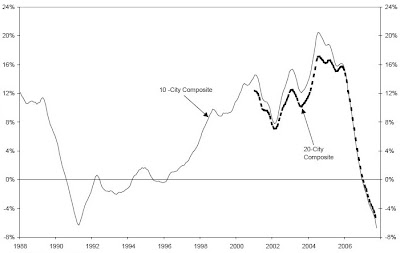
Case Shiller maintains a really nice index for tracking the value of single family homes in the US. It's a broad index, and is actually specific to only 20 US urban markets, but it contains lots of carefully vetted data points and is very dependable as a national metric. It's released the last Tuesday of every month.
The story it is telling right now is kinda bleak. If you look at the year over year change back to the late 1980's, the last year and a half are a precipice:
And if look at individual performance of the 20 individual markets over the same 20 year period you get this thing:
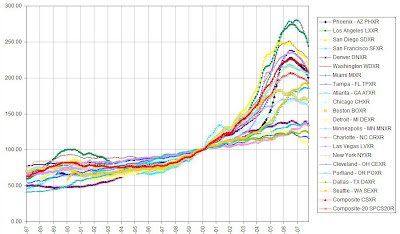
Click it into its own page if you want to read it, but that's not really necessary. The trend is the trick. A dozen of these cities (note especially LA, Miami, San Diego and DC at the top of the bubble) have peaked so completely out of line with their historic curves that there's no hope of getting them moving back upward any time soon. Since many of these markets are still at more than 200% of their January 2000 index value they'll probably fall for another year at least - without even considering energy or currency crisis possibilities.
If the lines settle back down somewhere near the 2000-2001 baseline and make nice, neat bellcurves of themselves, well, oops. There's something like 5 trillion dollars of value under that curve. With that gone (and the equity markets flat or falling, which seems sort of inevitable) it doesn't look like we'll be feeling so flush over the coming years.
I think it's safe to say that this sort of residential value inflation, while natural and common as a local phenomenon, is a very bad sign when it happens across the entire national economy. And perhaps we should rethink the policy of making credit so readily accessible for residential real estate speculation (like for the millions of houses that were bought not to be owner-occupied but purely to make money riding the wave up). Because it is one thing to watch your stock portfolio crash - it's a very different thing to lose your home.
The story it is telling right now is kinda bleak. If you look at the year over year change back to the late 1980's, the last year and a half are a precipice:

And if look at individual performance of the 20 individual markets over the same 20 year period you get this thing:

Click it into its own page if you want to read it, but that's not really necessary. The trend is the trick. A dozen of these cities (note especially LA, Miami, San Diego and DC at the top of the bubble) have peaked so completely out of line with their historic curves that there's no hope of getting them moving back upward any time soon. Since many of these markets are still at more than 200% of their January 2000 index value they'll probably fall for another year at least - without even considering energy or currency crisis possibilities.
If the lines settle back down somewhere near the 2000-2001 baseline and make nice, neat bellcurves of themselves, well, oops. There's something like 5 trillion dollars of value under that curve. With that gone (and the equity markets flat or falling, which seems sort of inevitable) it doesn't look like we'll be feeling so flush over the coming years.
I think it's safe to say that this sort of residential value inflation, while natural and common as a local phenomenon, is a very bad sign when it happens across the entire national economy. And perhaps we should rethink the policy of making credit so readily accessible for residential real estate speculation (like for the millions of houses that were bought not to be owner-occupied but purely to make money riding the wave up). Because it is one thing to watch your stock portfolio crash - it's a very different thing to lose your home.
Thursday, January 10, 2008
the assassination of barack obama
As his symbolic potency increases, so does his potential utility as a target. "We can throw the whole house into chaos. All we've got to do is knock over this tower." This is what the vandals say.
(that we don't care what madness motivates the vandals doesn't diminish their danger)
Barack Obama, already, has shown strong heroic stuff. He knows the creeping, mediocre beasts are watching him grow and he persists, thrives, in spite of this. But the risk is real and he can't leave his legacy to chance. He must not make the terrible mistake of dying without a will.
He must, in fact, acknowledge and embrace his affinity with the great martyrs who have come before him. He must be buoyed and inflated by this association. And he must be explicit, must tell his potential successors how to behave if the terrible thing happens (as his spiritual progenitors have passed it down to him):
(that we don't care what madness motivates the vandals doesn't diminish their danger)
Barack Obama, already, has shown strong heroic stuff. He knows the creeping, mediocre beasts are watching him grow and he persists, thrives, in spite of this. But the risk is real and he can't leave his legacy to chance. He must not make the terrible mistake of dying without a will.
He must, in fact, acknowledge and embrace his affinity with the great martyrs who have come before him. He must be buoyed and inflated by this association. And he must be explicit, must tell his potential successors how to behave if the terrible thing happens (as his spiritual progenitors have passed it down to him):
Tuesday, January 8, 2008
mccain, obama + the great healing
Slate talks about the curious similarity of these two guys, how they are both anti-politicians focused on addressing partisan flaws in the American political process, how they are more authentic than their rivals.
Behold my electoral fantasy: Democrats nominate Obama without a running mate on August 28. Republicans nominate McCain without a running mate on September 4. On September 11, 2008 the RNC and DNC simultaneously announce their tickets. Republican: McCain and Obama; Democrat: Obama and McCain.
Over the next two months, America fights hard to determine who sits in which chair, but regardless of outcome, bipartisianship is internalized into the White House and we can all breathe a sigh of relief as a composite agenda begins moving forward at respectable speed.
I know, this is so far beyond the realm of the imaginable that it hardly rates a chuckle. Because in America it's more fun to be about the ride than the destination. And easier to define ourselves against the other guy rather than against the sharp claws of the real enemy.
But a lot of us could be inspired by a government that went all the way to the bottom of the well to find its center, to weave its opposite ends together, to capture the collective national sentiment and slingshot America into its destined role. Pity that this concept sounds so foreign and foolish.
Behold my electoral fantasy: Democrats nominate Obama without a running mate on August 28. Republicans nominate McCain without a running mate on September 4. On September 11, 2008 the RNC and DNC simultaneously announce their tickets. Republican: McCain and Obama; Democrat: Obama and McCain.
Over the next two months, America fights hard to determine who sits in which chair, but regardless of outcome, bipartisianship is internalized into the White House and we can all breathe a sigh of relief as a composite agenda begins moving forward at respectable speed.
I know, this is so far beyond the realm of the imaginable that it hardly rates a chuckle. Because in America it's more fun to be about the ride than the destination. And easier to define ourselves against the other guy rather than against the sharp claws of the real enemy.
But a lot of us could be inspired by a government that went all the way to the bottom of the well to find its center, to weave its opposite ends together, to capture the collective national sentiment and slingshot America into its destined role. Pity that this concept sounds so foreign and foolish.
Saturday, January 5, 2008
energy myopia
For your consideration, a simple graph...

...depicting global, commercial energy production since 1800. Despite a few small hiccups, all of the lines, and especially all of them taken together, move in only one direction. Up.
And it's pretty easy to interpret the big story from this little picture: the entire viability of the Developed World, since industrialization's first meek stirrings in the 1840's, has been premised on an ever increasing consumption of energy.
What with oil over $100 a barrel now and all the talk about clean and sustainable energy development, you'd hope this picture was familiar to the people who stand to do most with it (like maybe the head of government of the world's largest economy). Let's see what America's presidential candidates would do about our looming energy predicament.
First, the Democrats:
And the Republicans:
Yes, the Democrats come off as somewhat more enlightened, but that's not the point here. My point (which none of these good folks cares to address) is that for 200 years the core assumption of our stability and affluence is sustained growth through ever greater energy gulps. Yet all anyone wants to talk about is use reduction and source swapping. Which makes no sense, since if you're basing forecasts on current use you're bucking every trend of the last two centuries, so what you should be talking about is how we're going to manage the seismic consequences of bucking every trend of the past two centuries.
There's such an opportunity here to frame this energy/environment/growth plateau issue and make a stand. Real hinge of history stuff. Yet no one even hints at it.
And I wish someone would get this issue, this do we really think we're gonna grow forever issue, out in public. Because the time is coming when the climate vs. comfort question has to get answered - when some combination of economic and political pressures forces a decision about whether we backslide to dirty energy or suck it up and do the hard work it takes to transcend the carbon lifestyle for real. And when that day comes it would be nice to have a president with the backbone to make the hard choice.

...depicting global, commercial energy production since 1800. Despite a few small hiccups, all of the lines, and especially all of them taken together, move in only one direction. Up.
And it's pretty easy to interpret the big story from this little picture: the entire viability of the Developed World, since industrialization's first meek stirrings in the 1840's, has been premised on an ever increasing consumption of energy.
What with oil over $100 a barrel now and all the talk about clean and sustainable energy development, you'd hope this picture was familiar to the people who stand to do most with it (like maybe the head of government of the world's largest economy). Let's see what America's presidential candidates would do about our looming energy predicament.
First, the Democrats:
Clinton would: decrease US foreign oil consumption by 50% by 2025; develop 20% renewable energy standard for power companies; make federal buildings carbon neutral;Hmm. Richardson actually seems to have a sense of the magnitude and urgency of the situation (though you'd hope so since he used to be the Energy Secretary). Too bad he's not sufficiently "presidential" (read: slightly chubby) to have any shot at the nomination.
Edwards would: reduce fossil fuel dependence through $13B "New Energy Economic Fund"; develop 25% renewable energy standard for power companies; allocate $1B for automakers to apply latest technology; raise fuel economy standard to 40 mpg by 2016; promote ethanol use
Obama would: decrease US foreign oil consumption 50% by 2025; support ethanol and blended fuel initiatives; support coal to liquid fuel legislation
Richardson would: "make the US the Saudi Arabia of wind, solar and biomass"; move vehicles toward 100 mpg; push for 20% improvement in US energy productivity; reduce foreign oil to 10% of total
And the Republicans:
Giuliani would: support increased use of nuclear power and probably lean heavily on the advice of the fossil fuel-oriented energy companies he's consulted for or represented legallyThe collective dedication to nuclear by the Republicans should raise a red flag. I'll be the first to agree that fission has its role to play, but blurting this out to the exclusion of a truly considered policy suggests magical thinking of the "salvation by technology" variety.
Huckabee would: support increased use of nuclear power, drill in the Arctic National Wildlife Refuge and "promote alternative fuel technologies"
McCain would: promote a system of greenhouse gas tradeable allowances and greatly increase the use of nuclear power
Romney would support drilling in the ANWR and the Outer Continental Shelf, increase energy efficiency in government buildings and vehicles, promote biofuel development, increase the use of nuclear power and "work to make the US energy self-sufficient in the next couple of decades"
Yes, the Democrats come off as somewhat more enlightened, but that's not the point here. My point (which none of these good folks cares to address) is that for 200 years the core assumption of our stability and affluence is sustained growth through ever greater energy gulps. Yet all anyone wants to talk about is use reduction and source swapping. Which makes no sense, since if you're basing forecasts on current use you're bucking every trend of the last two centuries, so what you should be talking about is how we're going to manage the seismic consequences of bucking every trend of the past two centuries.
There's such an opportunity here to frame this energy/environment/growth plateau issue and make a stand. Real hinge of history stuff. Yet no one even hints at it.
And I wish someone would get this issue, this do we really think we're gonna grow forever issue, out in public. Because the time is coming when the climate vs. comfort question has to get answered - when some combination of economic and political pressures forces a decision about whether we backslide to dirty energy or suck it up and do the hard work it takes to transcend the carbon lifestyle for real. And when that day comes it would be nice to have a president with the backbone to make the hard choice.
Subscribe to:
Posts (Atom)
